Introduction
Biology and Some Major Fields Of Specialization
Biology is the study of living things. It is a branch of science and, like other science, it is a varied way of understanding nature. Biology deals with the living part of nature and with the non-living things, which affects the living things in many ways. I strive to understand, explain, interpret, and describe the natural world of living things. The literal meaning of biology is also the study of life.
Definition of Life
It is very difficult to define life. There are certain aspects of life that lie beyond the scope of science of biology like the answer to the question:
What is the meaning of life?
Why should there be life?
These are the questions not really taken up by biologists and are left to philosophers and theologians. Biologists mainly deal with the matter relating to how life works.
Life for biologists is a set of characteristics. This is what distinguishes living organisms from non-living objects, including dead organisms. Living organisms are highly recognized complex entities, and they are composed of one or more cells; contain genetic programs of their characteristics; can accrue and use energy; can carry out and control numerous chemical reactions; can grow in size; maintain a fairly constant internal environment; produce offspring similar to themselves; and respond to change in their environment.
Numerous Quranic injunctions emphasize the study of biology. These describe the study of organisms and their different aspects of life. Modern biologists believe that “Life had originated in oceans first and then migrated to land.”
The Holy Quran says:
“Have not those who disbelieve known that the heaven and earth were one piece, then We parted them? And We made every living thing of water? Will they not then believe?” (Al Quran 21:30)
And about the origin of life. It is suggested that life must have begun with some simple cell and with the passage of time, if involved in the plants and animals of today. If there is to be a subconscious appearance of life, the beginning must involve some chance associations of atoms.
The Holy Quran describes the origin of life as
“Lo, We created them of plastic clay” (Al Quran 37:11)
“O mankind, be careful of your duty to your Lords. How created you form a single soul, and from it created its mate, and from them twain, hath spread about a multitude of men and women.” (Quran 4.1)
It is believed that primitive Earth had an atmosphere of methane, ammonia, water vapours, hydrogen, sulphide, and hydrogen. These simple substances gradually combine into complex molecules which serve as models for organizing chemical substances around them. In this respect, Quran emphasizes:
“See they not how Allah produceth creation, then reproduceth it? Lo! Allah That is easy.”
Any object processing all these characteristics simultaneously can be declared as a living thing and is an object for biological studies.
The science of biology is a very wide-ranre of subject. It includes every context of our living things. Therefore, volumes and volumes of information are available on the web, and it is but natural to divide this science into quite a number of branches for our consumption of comprehensive living and studying biology.
You are surely familiar at this stage with
- Ecology,
- Embryology
- Physiology
- Immunology
- External Morphology
- Iternal Morphology
- Anatomy
- Palaoecology
Histology, Evolution, genetics, cells, biology, zoology, etc. There are branches of biology which deals with environmental relations, development, structure, function, form, and internal growth, structure, fossil issues, ancestral histery, heredity, and distribution of animals in nature, respectively. In addition to their branches, there are a number of other branches of biology, such as microbiology, molecular biology, microbiology, marine biology, environmental biology, freshwater biology, parasitology, human biology, social biology, biotechnology, etc:
Molecular Biology
Molecular Biology is a branch of biology that deals with the structure of organisms, cells, and their organelles at the molecular level.
Environmental Biology
It is the study of organisms which in relation to their environment. This includes interactions between the organisms and their inorganic and organic environment, especially as it relates to human activities.
Microbiology
This is the study of microorganisms, which include bacteria, viruses, protozoa, and microscopic algae and fungi.
Freshwater biology.
This branch of biology deals with the organisms living in freshwater bodies, for example, like rivers, lakes, etc. This branch is also analyzes the physical and chemical parameters of these water bodies.
Marine biology.
It is the study of life in the seas and oceans and is called marine biology. This includes the study of marine life and the physical and chemical characteristics of the sea, acting as factors for marine life.
Parasitology
This is the branch of biology that deals with the study of parasitic sites, and it also involves the structure, modes of transmission, life cycles, histories, and hosts. Parasite relationships are studied in parasitology.
Human Biology
It deals with the study of humans. This includes form and structure functions, astrology, anatomy, macromorphology, biology, evolution, genetics, cell biology, ecological studies, etc. of human beings.
Social Biology
This is the branch of biology that deals with the study of social behavior and communal life of human beings. Biotechnology it deals with the study it deals with the use of living organisms, systems, or processes in manufacturing and service industries.
The levels of biological organization
Hundreds of chemical reactions are involved in maintaining the life of even the simplest organisms.
In view of this, it is something of a surprise to find that of the 92 naturally occurring chemical elements.
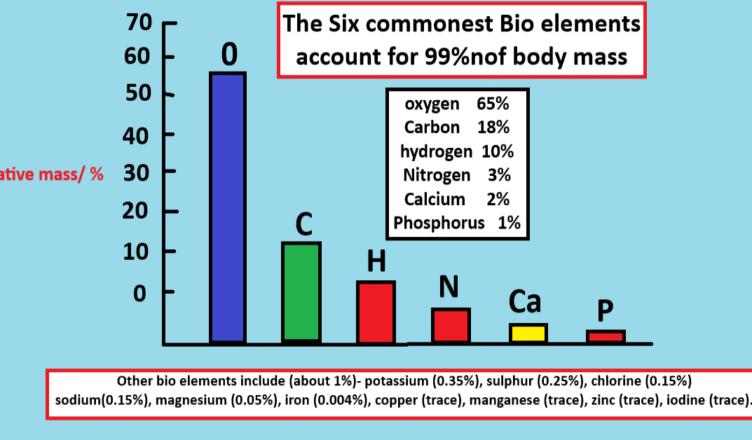
Only sixteen (16) are commonly used in forming the chemical compounds from which living organisms are made. These 16 elements and a few others that occur in particular organisms are called bioelements.
In the human body, only six bioelements account for 99% of the total mass is present.
The fact that the same 16 elements occur in all organisms and the fact that their properties differ from those in the non-living world. It is shown that bioelements have special properties, and it’s these that make them particularly appropriate as a basis for life.
Biochemical organization is not simple. Biochemicals is a high degree of complexity, because of which the living organisms are able to carry out a number of processes (some very complicated) that distinguish them from the non-living things. Non-living things have built-in regularity mechanisms that interact with the environment to sustain their structural and functional integrity.
It is also a dwelling component and consists of a distinctly established living substance. If you want to understand the numerous phenomena of existence, biologists have, for their convenience. It studies the organic organization at exceptional tiers, starting from the very primary stage of subatomic and atomic particles to the organism itself and beyond. This consists of taking a look at the community, population, and the entire international.
Organic agencies can also be divided into the following levels.
Levels of organization is given below:
- Biosphere: That part of Earth inhabited by living organisms includes both the living and the non-living components.
- Ecosystem: A community together with its non-living surroundings.
- Community: It is two or more populations of different species living and interacting in the same area.
- Population: Members of one species inhabiting the same area.
- Species: Very similar, potentially interbreeding organisms.
- Molecular organisms: An individual living thing is composed of many cells.
- Organ system: It also has two or more organs working together in the execution of specific body functions.
- Organ Systems: Two or more structures normally composed of several tissue types that form a functional tissue.
- Tissue: A group of similar cells that perform a specific function.
- Cells: The unit of life.
- Organelle: A structure within a cell that performs a specific function.
- Micro-molecules and Macro-molecules: A combination of atoms.
- Atoms: The smallest particles of an element that retainthe properties of the element.
- Subatomic particles: Particles that make up an atom.
Atomics and subatomic levels
All living and nonliving matter is formed of simple unit called atoms and subatomic particles such as protons, electrons, and neutrons.
Molecular level
In these organisms, elements usually do not occur in an isolated form. Such as these atoms of different elements combine through ionic or covalent bonding to produce. This stable form is called a molecular molecule.
Hydrogen, carbon, oxygen, nitrogen, phosphorus, and sulfur are the most common atoms found in biological molecules. The different types of bonding arrangements permit biological molecules to be constructed in a great variety and complexity. These may be micromolecules with low molecular weight, like CO₂, H2O, etc., or micromolecules with high molecular weight, e.g., stretch protein etc.
The biological world has two types of molecules:
- Organic
- Inorganic
Organic Molecules
An organic molecule is any molecule containing both carbon and hydrogen.
2. Inorganic molecules
Such as inorganic molecules do not include carbon and hydrogen together in molecules.
An organism is usually formed by an enormous number of micro and macro molecules of hundreds of different types, Some most important and abundant organic molecules in organisms are glucose, amino acids, fatty acids, glycerol, nucleotides like ATP, ADP, AMP etc.
ATP stands for Adenosine Triphosphate
- ATP is the primary energy carrier in cells.
Contains adenosine (a combination of adenine and ribose) and three phosphate groups.
ADP is stands for Adenosine Diphosphate
-
Formed when one phosphate group is removed from ATP.
- Contains adenosine and two phosphate groups.
AMP stands for Adenosine Monophosphate
-
Formed when another phosphate is removed from ADP.
-
Contains adenosine and one phosphate group.
These molecules are crucial in cellular energy transfer and metabolism
It’s fascinating how mods like Spunky Game breathe new life into classics like Incredibox, blending creativity with fresh beats and visuals. A true testament to fan-driven innovation!
Matagal na akong naglalaro sa 66wins.org, at masasabi kong mapagkakatiwalaan ito. Maraming klase ng slot, mula classic hanggang sa mga bago. Ilang beses na akong nanalo, at sobrang saya tuwing may jackpot 🍀.